


Today, plastic is everywhere around us, from everyday products to industrial machinery. As you know, there are numerous types of plastic. Among its wide variety, acetal and Delrin are the two most widely used engineered plastics. At first, these plastics appear similar because they originate from the same source. This can be confusing for people. However, both plastics vary in several aspects, leading to a debate: Acetal vs Delrin, which one is truly the best?
Genuinely speaking, acetal and Delrin are strong, durable, and reliable. However, they serve different purposes due to their distinct properties. That’s why, to make an informed decision, you have to understand their key differences. Are you new to these engineered plastics? Don’t worry! In this article, I will discuss the differences between acetal and Delrin and which one you should choose. So, let’s get started!
Acetal vs Delrin: 10 Key Distinctions

As I said above, acetal and Delrin are now becoming top choices in several industries due to their strength. However, these two plastics are not identical. If you want to choose one for your business, you first have to understand their differences. So let’s dive in and explore the factors that make acetal and Delrin quite different.
1- Basic Definition & Origin
Let’s start with the definitions of acetal and Delrin.
Acetal, also known as polyoxymethylene (POM), is a type of plastic developed in the 1950s. Basically, it is an engineering thermoplastic. This means you can shape it into any form when it is heated. However, on cooling, it becomes very stiff and strong.
When discussing types of acetal plastic, there are two primary forms. The first one is homopolymer plastic. This type is made with the same repeating units as the acetal. That’s why homopolymers are highly organized and strong. The second form of the acetal is a copolymer. It is made by combining two different monomers. This is done to enhance some properties of acetal.
Delrin is a specific brand name for a type of acetal homopolymer. It was created by the chemical company DuPont in 1960. You can consider it a “premium version” of acetal as it is made with very high quality and consistency. That’s why Delrin performs reliably and predictably.
In simple terms, Delrin is a high-quality brand of acetal homopolymer. Homopolymer means Delrin contains the same repeating units of acetal. That’s why it has highly consistent and improved qualities and performs very well in demanding applications.
2- Material Type
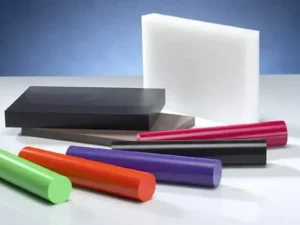
Material type means the form in which both acetal and Delrin come. This is another key difference between these two plastics. For example, acetal, as I said above, comes in two forms. The first one is the homopolymer acetal. It is made from the same repeating units, so a homopolymer has greater consistency. The second form of acetal is the copolymer acetal.
This acetal type is made using different monomers. This is done to achieve two distinct properties. For example, if you want to improve the acetal’s humidity resistance, you can mix it with humidity-resistant monomers. On the flip side, Delrin does not have a second form. It is the brand version of the homopolymer. Delrin is available only as a homopolymer—there is no copolymer version.
3- Mechanical Strength
Another key difference between acetal and Delrin lies in their mechanical strength. Mechanical strength is the maximum load a specific material can withstand before bending or breaking. If we discuss acetal, it is naturally strong and stiff. Its homopolymer version can withstand heavy loads. But copolymer acetal is designed for heat and moisture resistance, so it might not withstand heavy forces. So, you can say that acetal has moderate mechanical strength.
On the other hand, Delrin has exceptional mechanical strength. Why? Because it is actually a homopolymer, which means it is made using the same and constant units. This consistency results in a tightly packed internal structure, enabling it to withstand heavy loads. You might think that acetal also forms a homopolymer, so it is the same as Delrin. But that’s wrong. Actually, Delrin is manufactured under controlled conditions, so it has higher mechanical strength.
4- Wear & Friction Resistance
Friction resistance is how well a material can handle rubbing, sliding, or moving against another surface. So it is another aspect in which acetal and Delrin differ. For example, acetal has low friction and moderately good wear resistance. This means acetal can slide over other surfaces without getting damaged or heated.
Its homopolymer version works well in high-stress moving parts, thanks to its internal consistency. However, the copolymer acetal might not have good friction and wear resistance. This is because the copolymer is designed with other improved properties.
In contrast, Delrin is highly wear-resistant and friction-resistant. It has a tightly packed crystalline structure due to its homopolymer nature and controlled manufacturing. So, when Delrin is rubbed against another moving surface, it does not get damaged or worn. That’s why, when Delrin is used in moving machinery parts, it doesn’t need lubrication.
5- Chemical Resistance
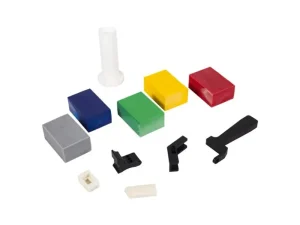
Resistance to chemical exposure also sets acetal and Delrin apart. How? Actually, acetal can resist several chemicals, including grease, oil, and alcohol. The copolymer acetal is even more resistant to harsh chemicals, such as acids and bases, and does not degrade. This is due to the improved qualities of the copolymer acetal.
It is made with a different chemical-resistant molecule, which enhances its chemical resistance. However, Delrin is somewhat compromised in terms of chemical resistance. It contains the same repeating units, which do not improve its resistance to chemical exposure. However, Delrin can still withstand less harsh chemicals, such as lubricants and automotive fluids.
6- Thermal Properties
Thermal properties refer to how a material behaves when exposed to heat. This is another main distinction between acetal and Delrin. For example, acetal can handle temperatures up to about 90–100°C (194–212°F) without deforming. This is significant thermal stability under normal conditions.
However, under harsh thermal conditions and prolonged exposure to heat, even the copolymer acetal might melt. On the flip side, Delrin has better thermal resistance than acetal. It can also withstand about 100°C, but it retains its mechanical strength and stiffness better. It means that Delrin can be exposed to heat for a long time without deteriorating or changing shape.
7- Dimensional Stability
Dimensional stability refers to a material’s ability to maintain its shape and size over time. When choosing plastic, you also have to consider the factor that distinguishes acetal from Delrin. For example, copolymer acetal has good dimensional stability under stress. It retains its original, well-maintained form in cold or humid environments. This is because copolymer acetal is made from humidity-resistant monomers.
However, Delrin has exceptional dimensional stability. Why? The reason lies in its uniform, well-organized crystalline structure. It is even more stable than copolymer acetal. When you expose Delrin to humid environments, it does not absorb water and stays the same as the original. In short, Delrin does not change in size or shape due to humidity or stress.
8- Machinability & Workability
Machinability and workability refer to how easily a material can be cut, shaped, and worked with. It is another aspect that differentiates both acetal and Delrin. For example, acetal has excellent machinability. You can easily cut, drill, or use it in an injection mold to create different shapes. However, acetals sometimes chip when machined. So you have to be careful. Moreover, if you want precision, acetal might not be a good choice.
The reason is that it lacks a uniform structure, which affects precision. On the flip side, Delrin is exceptional for its workability and machinability. Unlike acetal, it does not chip and has low friction, which makes the process easier. Furthermore, Delrin has a crystalline, uniform structure. This uniformity allows you to achieve tight tolerances and high-precision parts.
9- Applications & Best Use Case
Due to variations in terms and usage, the uses of both acetal and Delrin vary. Both are used for different purposes and fit different jobs. For example, acetal is a highly versatile material. That’s why acetal is used in:
- Gears and sprockets in machines.
- Bearings and bushings
- Automotive components (clips, fasteners, fuel system parts)
- Plumbing components (pipes, valves, fittings)
- Household appliances (washing machines, kitchen tools, vacuum parts)
- Conveyor components and rollers
On the contrary, Delrin is known for its precision, durability, and strength. Therefore, it is used in:
- Precision gears and mechanical components.
- High-performance bearings and bushings.
- Automotive parts (engine components, fuel system parts, seat mechanisms)
- Aerospace components (lightweight, high-strength parts).
- Industrial machinery parts are under heavy loads or constant movement.
- Medical devices require strength and precision.
10- Cost & Availability
Finally, the most important differentiating factor is the cost and availability of acetal and Delrin. For instance, acetal is a more affordable plastic. Why? The first reason is that it is readily available and manufactured worldwide. Also, acetal is available in two versions, so you can choose whichever suits your needs. Secondly, the manufacturing of acetal is not demanding, which further makes it cost-effective.
However, Delrin is more expensive and of higher quality than acetal. The reason for its higher cost is its high quality, consistency, and superior performance. The manufacturing process of Delrin is also not straightforward, so it is rarely available in the market. However, in my opinion, Delrin’s long-term performance compensates for its higher price.
Acetal vs Delrin: Which One Should You Choose?
There is no one-size-fits-all answer to this question. It highly depends on the needs of your project. So,
If you want a strong, reliable, and long-lasting material, Delrin is the better choice. Delrin is an ideal option for long-term performance and the production of precision parts. However, it also has a high cost due to its high quality and consistency. But if your priority is moderate strength needs or requires chemical resistance at a lower price, Acetal is sufficient.
Remember, before making the final choice between acetal and Delrin, you must consider all aspects of both plastics. For example, acetal is a versatile and widely available plastic. It comes in two types, giving you the flexibility to choose the option that best suits your needs.
However, if your project needs higher thermal stability or precision parts, acetal might not be a good choice. It can lose its shape at higher temperatures or in colder conditions. So you have to be very careful about this. On the other hand, Delrin, a branded homopolymer acetal, is stronger and more durable.
If you need high strength, thermal and dimensional stability, and precision, Delrin is a superior option. It can withstand harsh chemicals and outdoor conditions without losing its shape. However, Delrin is comparatively expensive due to its branded qualities. But if you are working on critical projects, I highly recommend investing in Delrin.
