


Plastics are commonly used to make a wide range of products. From TV remotes to laptop cases, these materials are found everywhere. The most common plastics are ABS (Acrylonitrile Butadiene Styrene) and TPU (Thermoplastic Polyurethane). However, they differ, leading to a comparison of ABS vs TPU.
Interestingly, both of these materials are thermoplastic. This means you can melt them when you want their softened form. Similarly, upon cooling, these plastic types become hard and strong. These two plastic types differ in many ways. In this article, I will compare both ABS and TPU head-to-head and discuss their differences.
What are the Differences Between ABS and TPU?
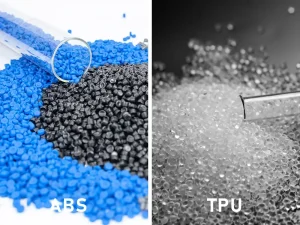
It is noteworthy that both ABS and TPU share many properties. However, this article focuses on their differences, so you can decide which is a better option for you. Let’s jump into it and explore the fundamental differences between ABS and TPU.
1- Flexibility level & Elastic behavior
ABS is known for its rigidity and has no noticeable flexibility. In fact, this is one of the key reasons behind its widespread use. Products made with ABS are generally hard and dimensionally stable. On the other hand, TPU is a plastic with excellent elasticity. When subjected to force, this material can bend and stretch easily.
Interestingly, this material also regains its shape when force or stress is removed. The reason behind this flexibility is its excellent elastic molecular chains, which can move. This makes TPU great at absorbing sudden shocks without being damaged. ABS can crack or break under high stress, whereas TPU can bend rather than break.
2- Strength & Impact Resistance
Both of these plastic types are stronger and better in different ways. ABS is very hard and rigid, and remains dimensionally stable even if you hit it. In simple terms, this material is stronger when struck. On the other hand, TPU is strong in terms of the force it can withstand. As mentioned above, TPU is flexible and deforms under impact.
Even under extreme loads, this material maintains its integrity thanks to its ability to bend. TPU has excellent impact resistance. Remember, ABS can break if exposed to extreme stress, as it cannot absorb the impact. So it is not easy to announce one as better than the other. If you need hardness, choose ABS. Similarly, you should select TPU if your application needs better impact resistance.
3- Abrasion & Scratch Resistance
Both of these materials are abrasion-resistant. However, the TPU performs better against repeated abrasion or scratches. ABS is hard, so it can withstand mild abrasion or friction. However, it can wear out from repeated abrasion or friction.
On the flip side, TPU has excellent flexibility and can bend under abrasion. Once you scratch it, the TPU material will bend and absorb the minor impact. Even if you repeatedly scratch it, this material will keep bending. As a result, you won’t notice any wear and tear on the TPU, even when it’s scratched repeatedly.
4- Durability & Warping Tendency
ABS is durable due to its rigidity and can withstand mild impact. Additionally, this material maintains dimensional stability, another significant advantage. However, it can warp, especially when the temperature changes. Moreover, releasing this warping is very difficult, which is a downside.
So products made from it can be prone to twisting and deforming over time. On the other hand, TPU is durable because it absorbs impact. Moreover, it has excellent warp resistance. Firstly, it does not warp easily due to its flexibility. Even if it warps, correcting any warping is straightforward due to its elasticity.
5- Heat Resistance & Thermal Stability
ABS is a better option than TPU for heat resistance and thermal stability. As mentioned above, this plastic is stiff and rigid. So when heated, it remains stable and does not soften easily. Its internal structure is very robust, ensuring better performance.
On the other hand, TPU is less heat-resistant and less thermally stable. The reason is that the material is rubber-like and very soft. When heated, this material softens and eventually melts. It does not maintain its structure and quickly loses it. I recommend using ABS, especially when making products intended for high-temperature use.
Quick Note: The behavior of these plastics changes when used at low temperatures. ABS becomes more brittle and prone to breaking at low temperatures. It loses its structural integrity and is not suitable for cold environments. On the other hand, TPU keeps its flexibility and performs excellently at very low temperatures.
6- Chemical, Oil, and Grease Resistance
ABS material can withstand contact with mild chemicals and water. It does not deteriorate even with prolonged exposure to water. However, its molecular structure is affected when it comes into contact with oil or grease. You may also notice some swelling on this material when exposed to oil or grease for an extended duration.
On the other hand, TPU performs excellently in all conditions. It can easily resist chemicals, water, oil, and greases. It has a rubber-like structure, which is key to repelling the oil and grease. Therefore, manufacturers generally prefer TPU for products used in oily conditions. Conversely, ABS is a suitable option for moist or low-chemical-contact applications.
7- Ease of Injection Molding & 3D Printing
Injection molding and 3D printing are two critical manufacturing processes. They involve melting materials and forming solid products from the molten state. Injection molding uses a mold for shaping products of complex shapes. On the other hand, 3D printing uses dedicated 3D printers that melt filaments and deposit the molten material layer by layer.
ABS is typically considered a superior option for both injection molding and 3D printing. The reason is that this material is thermally stable. When it is heated, it melts smoothly, and its molten form can be handled easily. As a result, even beginner-level operators can use this material for both injection molding and 3D printing.
Conversely, TPU is less thermally stable and is very soft. When it’s hot, it flows very quickly, which is a significant drawback. Handling this molten form is a bit more challenging. So using it for both injection molding and 3D printing is more challenging. Remember, it requires expertise and experience to handle the fluidity of this material in its molten state.
Additionally, printing speed decreases when using TPU material. Both of these plastics produce fumes during 3D printing. These fumes are generally more prominent during the melting of these materials. ABS fumes are usually more intense than TPU. Therefore, I highly recommend wearing safety masks during 3D printing.
8- Cost & Applications
Both ABS and TPU differ in terms of cost and applications. In fact, cost can be a major differentiator between ABS and TPU. ABS is a material with complex properties that simplify production, which is the primary reason behind its lower cost.
In contrast, TPU is a premium material but is more complex to produce. Additionally, this rubber-like plastic is sensitive, and it’s more challenging to handle. So, the cost of TPU is typically higher than that of ABS. Regarding applications, ABS is used to make products that require hardness and rigidity. On the other hand, TPU is preferred for making products that require abrasion and chemical resistance.
Here is the table showing the application of both ABS and TPU materials:
| ABS Applications | TPU Applications |
| Electronic housings | Phone cases |
| Automotive interior panels | Shoe soles |
| LEGO bricks | Industrial gaskets |
| Toys | Tubing and hoses |
| Plastic furniture | Protective covers |
| Tool casings | Watch straps |
| Switch covers | Sports equipment grips |
| Appliance casings | Seals and gaskets |
Frequently Asked Questions
Is TPU better than ABS?
Yes. TPU performs better than ABS due to its greater flexibility, abrasion, and chemical Resistance. However, it has a higher cost, which can be a drawback compared to ABS, which is inexpensive.
Does TPU break easily?
No. Generally, TPU does not break easily. Why? That’s because of its flexibility and elastic nature. When it is stressed, it stretches and bends, then regains its shape. This property makes TPU more stable and less prone to breaking.
Can ABS and TPU be combined in the same product?
Yes. It is possible to combine these two materials to make a single product. However, it requires a careful approach and understanding of the properties of both ABS and TPU.
Can ABS or TPU be recycled easily?
Yes. ABS and TPU can be recycled and are sustainable. However, the ABS is a slightly better option for ease of recyclability. TPU is somewhat more challenging to recycle and requires special processing.
Concluding: Which One to Choose, ABS or TPU?
As previously discussed, both of these plastic types are excellent in their own ways. So, their selection is more about what you need for your specific product. You should choose TPU if you want better performance, chemical, and impact Resistance. However, this material is costly, which can be a hurdle.
Additionally, it is less suitable for injection and 3D printing processes. If you’re looking for a budget-friendly option, I recommend ABS. This material offers optimal strength, heat resistance, and is easy to use, especially in 3D printing. In short, understand your specific use case, then choose between ABS and TPU.
