


Injection molding is one of the most popular methods for making plastic products. I bet on this. It works by injecting molten plastic into a mold cavity. There, it cools and solidifies into a finished part. But have you ever wondered how that molten plastic actually travels inside the mold to create intricate shapes? The credit goes to the types of runners in injection molds.
The runners play a crucial role in how smoothly the plastic flows and how fast the part is made. Interestingly, types and designs of runners highly affect the overall quality of products. That’s why understanding each runner type is crucial to attaining desired results. To make things clear, in this article, I will discuss the main types of runners in injection molds. So let’s get started!
What Exactly Is a Runner System In Injection Molding?
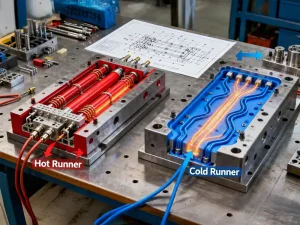
Let’s first understand the basics of the runner system in injection molds.
A runner system is actually a network of channels. It carries the molten plastic from the injection machine nozzle to the mold cavities where the parts are formed. In simple words, it acts like a pathway or pipeline that guides the hot, melted plastic to the right places inside the mold.
Without the runner system, the molten plastic wouldn’t reach all the cavities. As a result, your final product will be weak with defects and not properly shaped. If we go deep, you will see that the runner system is actually made of three main parts. Those include the sprue, the runners, and the gates.
The sprue is the main entry point for molten plastic into the mold. The runners are the connecting channels that distribute the plastic to different sections (molds). Finally, the gates are the small openings that allow the plastic to flow from the runner directly into the cavity. Together, these parts ensure a smooth and even flow of material during the molding process.
Types of Runners In Injection Molding
Now you have a basic understanding of the runner system. Right? It is now relatively easy to understand the different types of runners and how they work. So let’s dig down and explain the main types of runners.
1- Cold Runner System
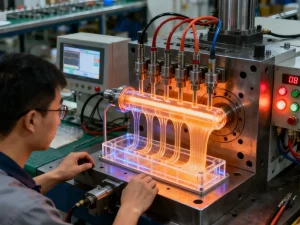
Cold runners are one of the most common types of runners in injection molding. They carry the molten plastic from machine nozzles to mold cavities. However, as the name suggests, cold runners are not heated. Instead, they remain the same as the mold’s temperature. When the molten plastic cools and solidifies, the cold runners also solidify.
In simple words, the cold runner gets stuck with the product. So when the final product comes out, cold runners also come out with it. However, this runner is not part of the final product. So it needs to be removed for the injection molding surface finish. You can also reuse or throw it away. Due to this easy operation, cold runners are easy and cheap to use. Moreover, molds for cold runners are easy to design and do not require any special heating components.
However, one drawback of cold runners I don’t like is the material waste. As I said above, after every cycle, these cold runners come out with the product. This waste can increase material costs, especially when you are using expensive resins. Also, if you recycle these cold runners, it can lead to extra cycle time and recycling cost. As a result, your delivery time can be affected, especially for large-scale production.
2- Hot Runner System
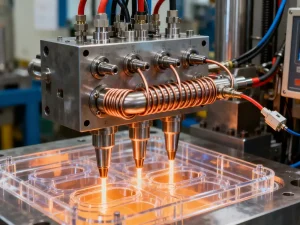
Hot runners are another advanced type of runner in injection molding. But this type of work is totally different from cold runners. HOW? Actually, in a hot-runner system, the runners are heated. It means the molten material stays hot as it moves through these channels and does not solidify inside. Instead, the molten material only hardens and cools as it enters the mold cavity.
But the question arises, how do the hot runners remain hot? Basically, these runners use electric heaters and temperature controllers. These heaters keep the plastic melted at all times as it travels through the mold. As a result, no additional solid plastic runner is produced. Only the final product comes out, with no runner. This not only reduces material waste but also speeds up the injection molding process.
However, the hot runner system is slightly more complex than the cold runner system. They require careful design and an advanced temperature control system. WHY? Because if there is no temperature control, the molten material can burn and block the channels. Due to this advanced system, I don’t recommend hot runners for beginners. They are mainly used by experienced manufacturers and for high-volume production.
3- Insulated Runner System
Insulated runners are a special type of injection mold runner that lies between hot and cold runners in design. Let me explain how these runners work. Actually, the insulated runners are surrounded by a thick layer of insulated material. They are not equipped with electric heaters like hot runners. This insulation keeps the molten material hot enough to flow through the molds.
At the same time, this insulation prevents the runner from solidifying like a cold runner. The temperature inside the runner is hot enough to keep the plastic melted. However, the outside of the insulated runner remains cool, like a mold. This design helps reduce material waste, as with hot runners. On the flip side, it also doesn’t need a complex heating system like a cold runner.
As a result, insulated runners are considered simpler and cheaper than other runner types. They are ideal for medium production levels, and the cost needs to be balanced. However, one drawback of insulated runners is that they are compatible with only a few types of plastic. If the plastic cools too quickly, it might block the runner and stop the process. So I suggest using an insulated runner for only thermoplastics.
Types of Runners Based on Designs
Apart from the main categories of runner systems, runners can also be divided by design and shape. These designs decide how the molten plastic flows inside the mold and how evenly it fills the cavities. Let’s take a look at the common types of runners based on design and how each one works.
1- Straight Runner
The simplest type of runner in injection molding is a straight runner. As the name suggests, these runners are straight channels or tubes. They connect the sprue directly to the mold cavity. There are no bends or curves, which makes it easy for molten material to travel. Moreover, due to the straight and direct path, there is very little resistance and pressure loss during flow.
As a result, the molten material reaches faster, thereby increasing overall production speed. Due to this simple design, straight runners are handy for single-cavity molds. In these molds, only one product is made at a time. So there is only a need to flow the molten material in one direction.
2- Tapered Runner
Tapered runners are the runners that have wide openings at the start, from where the molten material enters. However, as they move towards the gate (mold cavity), these runners become narrower. In simple terms, tapered runners are wider at the start and narrower at the end. This design enables the smooth flow of molten material. HOW? Actually, as the plastic moves through the runner, the narrowing shape increases the flow speed and pressure.
The molten plastic evenly fills all parts of the cavity. As a result, there is no chance of bubble traps or weld lines. Tapered runners are often used in multi-cavity molds. In these molds, the plastic needs to be distributed to multiple cavities simultaneously. So, tapered runners with a gradual diameter reduction help balance the flow and ensure all cavities are filled uniformly.
3- Fan or Fan Gate Runner
A fan or fan gate runner is a special type of runner that resembles a wide, flat fan. These runners are narrow at the beginning but become wider near the mold cavity (like a fan). This design helps distribute the molten plastic across a large surface of the mold. In other words, making large-area plastic products, such as panels, becomes easier with fan runners.
Moreover, when the plastic is spread evenly, the problem of air traps and wrapping is no longer an issue. Another benefit of the fan runner is that it helps control the flow rate. HOW? As you know, the ends of these runners near the mold cavity become wider. This slightly slows the flow of molten material. As a result, the material’s stress decreases, leading to better quality.
4- Loop, Tab, or Disk Runners
Loop runners are other runner types in injection molds that have a circular shape. As the name indicates, these runners form a circular path around the mold cavity. That’s why they are suitable for ring-shaped injection mold types. The loop design of these runners allows the molten plastic to flow evenly from all directions into the cavity.
As a result, uniform, symmetrical, and round parts are formed perfectly. However, the shape of these runners can vary slightly depending on the mold layout. For example, they could be like a full circle, loop, or disk. Yet, the purpose of all these shapes is to achieve even flow distribution throughout. These runners are primarily used to produce parts that require high-dimensional accuracy.
How to Choose the Right Type of Runner System? Effective Tips
You can see a wide variety of injection molding runners. All those runners are suitable for different projects. The type of runner you use can affect product quality, production speed, and material cost. So, let’s discuss what you should see when selecting a runner.
1- Production Volume
Production volume means the total number of parts you plan to produce using a mold. This is one of the most critical factors you must consider when choosing the right runner system. So if you are producing a small quantity of parts, a cold runner is usually the best choice. Why? Because it is simpler, cheaper, and easier to design and maintain. However, if you are manufacturing a large volume of parts, a hot runner system is a better option.
2- Part Complexity and Geometry
The shape and design of the part you are making play a big role in deciding which runner system you should use. If your part has a simple shape with uniform thickness, a cold runner system usually works well. However, when your part has a complex structure, such as thin walls or a detailed pattern, hot runners become a better choice.
3- Quality Requirements
The quality standards of your final product are key when choosing runners. If your product doesn’t require high precision, a cold runner system can be a practical and cost-effective choice. However, if you are making high-precision or aesthetic parts, then you will need a hot runner system.
4- Lead Time
Lead time means the total time required to produce your molded parts. The choice of runner system can significantly affect how fast you can start and finish production. If you need parts quickly, a cold runner system should be your go-to option. However, if you are planning for long-term, continuous production, a hot runner system can save more time.
5- Cost Constraints
Cost is one of the most important factors when choosing a runner system. As you know, every project has a budget. The cost of the runner system directly affects the project’s initial cost. If you are working with a limited budget, I recommend choosing cold runners. However, if precision and quality are your main concerns, you should go with hot runners. They are costly initially; however, for volume production, they can actually save money over time.
Frequently Asked Questions
Does runner design affect the quality of plastic parts?
Yes, runner design has a direct impact on the quality of plastic parts. A well-designed runner ensures an even flow of molten plastic, resulting in a high-quality product. However, if a runner is poor, it can lead to uneven filling, wrapping issues, or visible marks on the product.
Can recycled plastic be used in runner systems?
Yes, recycled plastic can be used in runner systems. However, it depends on the type of plastic and the product requirements. For example, in cold-runner systems, leftover solid runners are often reused in the next molding cycle. But remember, not all recycled plastics maintain the same quality as new material. So I recommend avoiding these plastics.
Can a single mold have multiple runners?
Yes, a single mold can have multiple runners. This setup is common when the mold is designed to produce various parts simultaneously. Each runner carries molten plastic to a different cavity. As a result, more identical parts are made in less time.
Conclusion
Injection molding is widely used for manufacturing plastic parts. It is known for its precision, ease of operation, and time-saving. However, in injection molding, you deal with several parts. Among those, runners in injection molds are of the utmost significance. Their design and quality affect the overall quality of your project.
These runners come in various types, as discussed in this article. Each runner has its own unique design, features, and function. Due to this variation, the runners also differ in price and lead time. So first, before making the final selection, you must look at the runner’s features. After that, understand your budget and your product’s design, and choose the most reliable runner for your project.
