


Today, most plastic parts are manufactured using blow molding or injection molding. These techniques are used to shape molten plastic into finished parts by using heat and pressure. Both processes are crucial in modern manufacturing, but they yield distinctly different results. We will help you compare blow molding vs injection molding.
Blow molding creates hollow objects such as bottles, while injection molding can form solid items like gears. If you choose the right method, you can significantly decrease your cost and improve your production speed. In this article, we will take a detailed look at blow molding and injection molding side by side. This guide will help you decide what they make and when to choose each one.
Differences Between Blow Molding and Injection Molding
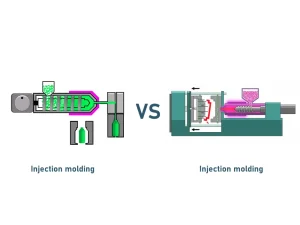
Both blow molding and injection molding utilize heat and pressure to shape plastic. However, they work in very different ways. The method you choose should depend on the type of final product that you will make.
Let’s take a look at the differences between blow molding and injection molding.
1- Process Overview
Blow molding forms hollow plastic parts by blowing air into a hot plastic tube inside a mold. The plastic expands and takes the shape of the mold. This is useful for cans, bottles, jugs, and many other hollow shapes.
Injection molding involves injecting melted plastic into a mold under high pressure. The plastic fills the mold and then cools. After that, a solid part comes out. This method is ideal for creating detailed and sturdy items, such as phone cases, toys, or furniture pieces like chairs.
2- Product Shape
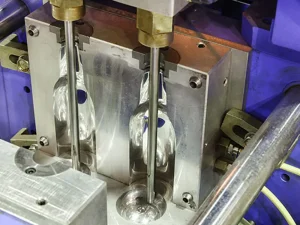
Blow molding is best for hollow parts because it blows air to push the plastic outward into the shape of the mold. It helps to create bottles and tanks.
On the other hand, injection molding forms strong parts. In this process, plastic is injected into the mold, resulting in the mold being filled with plastic. It is better suited for items like tools, casings, and products that require strong materials.
3- Material Usage
Blow molding uses less plastic because it creates thin walls, which makes the product lighter. Ultimately, it saves on material costs, mainly when producing millions of products.
Injection molding produces stronger parts, which must be sturdy and thick. Moreover, this method produces more solid parts instead of hollow ones. As a result, it uses more plastic. This method is better suited for parts that need to last longer or carry weight.
4- Mold Design
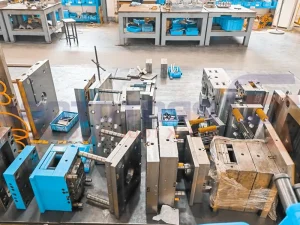
Blow molding uses simpler molds because the mold only shapes the outside of the item. It does not need to be as detailed. These molds are less expensive, which definitely helps when producing a large number of products.
Injection molding utilizes complex molds, which also have higher costs. They are complex because they require special features such as ejectors and cooling channels. They cost more initially but can produce millions of identical parts.
5- Cycle Time and Production Speed
Blow molding takes a bit longer because it involves more steps, like making the tube, then blowing into it, and finally, cooling. Newer machines have made this method somewhat faster, but it still has no comparison to injection molding.
Injection molding is a faster method, especially when making small parts. Machines fill the mold quickly and cool it in seconds. The production time is reduced significantly.
6- Wall Thickness Control
Injection molding enables manufacturers to have excellent control over wall thickness. The machine fills the mold with plastic under high pressure. This method helps to create strong and reliable parts.
However, blow molding does not offer the same level of control over the wall thickness. Because the plastic stretches inside the mold, some areas may become thinner than others. Even though new methods like Parison programming help, blow molding still struggles to maintain even walls.
7- Volume Comparison
Blow molding is most effective when factories need to produce a large number of simple, hollow parts. Companies often use a single mold to make millions of bottles, containers, jugs, and tanks. Since blow molding uses less plastic and cheaper molds, it keeps the cost low for high-volume jobs. The process also wastes less material, which helps lower expenses.
Injection molding is excellent for high-volume production. It works exceptionally well for solid parts that have complex designs. Even though they cost more to produce, they last a very long time and continue to deliver high-quality parts for an extended period. This is why injection molding is a wise choice for creating thousands or even millions of items.
8- Dimensional Accuracy
Blow molding offers less control over the dimensions of the part. The walls can stretch unevenly because plastic expands when air is blown into it. This method makes it challenging to maintain exact dimensions.
In comparison, injection molding gives you tight control over size and shape. The plastic fills the mold under pressure, ensuring that each part is produced consistently. This makes it a good choice for medical parts, clips, or other items that require a precise fit.
9- Surface Finish and Appearance
Blow molding produces parts with a basic surface finish. Since the plastic stretches and touches only the outside mold walls. It often leaves uneven textures.
In contrast, injection molding gives a smoother and more polished finish. The plastic fills every part of the mold, which makes it easy to add details. This method is most effective for parts that require a clean, professional appearance.
10- Recycling Issues
Recyclability also depends on the type of plastic, not the method itself. Both processes can utilize recyclable plastics, including PET, HDPE, and PP. Still, blow-molded parts are easier to recycle because they don’t contain embedded metal or multiple materials.
2-shot molding and Insert Molding, used in injection molding, make recycling more challenging. These parts often combine multiple materials into a single product. This makes it difficult to recycle and reuse.
Is Blow Molding More Expensive than Injection Molding?
Yes – injection molding is more expensive than blow molding. However, I consider the higher price of injection molding worth every penny.
The reason is that injection molding uses high-end tools and machines. Those machines and tooling can be expensive. However, you’ll see many people preferring injection molding over blow molding. The reason is that this method enables us to produce with exceptional quality.
You can achieve better dimensional accuracy and wall thickness. Moreover, the advanced tools will allow you to make more parts in less time. As a result, you can meet the strict deadline efficiently. Blow molding is a decent option, but it has several limitations. Despite its being inexpensive, people still prefer the injection molding process.
Environmental Impact of Blow Molding vs Injection Molding
Blow molding produces less plastic waste because it forms thin-walled and hollow objects. This process helps to reduce plastic waste. The molds for blow molding also require less energy to produce, resulting in energy savings.
Injection molding consumes more energy due to its high-pressure system and complex molds. It also generates more waste during start-up and trimming. However, many manufacturers recycle leftover plastic and use energy-efficient machines.
What to Choose: Blow or Injection Molding Method?
Each method fits different needs, and making the right choice can save time and cost during production.
Use blow molding if you need:
- Hollow parts like bottles, tanks, or containers
- Lightweight designs that use less plastic
- High-volume production of simple shapes
- Lower mold costs and faster mold development
Choose injection molding if you need:
- Solid parts like tools, casings, or structural components
- High strength and detailed features
- Tight tolerances and precise shapes
- Advanced methods like Insert Molding or 2 Shot Molding
Frequently Asked Questions
Which is better, blow or injection molding?
I consider injection molding a superior manufacturing method. It can create high-quality solid parts with exceptional dimensional accuracy. It also helps achieve ideal precision and can be used with a wide range of materials. Blow molding is a decent option for hollow parts and is a cheaper method.
Is blow molding cheaper for low-volume production?
Yes. Blow molding is an economical option for producing hollow parts in low volumes. However, I don’t consider this method the best suited for high-volume productions. Moreover, its precision and dimensional accuracy can also be a concern.
Does blow molding require complex molds?
Generally no! The mold used in blow molding is simple and easy to make. Creating such a mold is less expensive and does not require advanced skills. The mold used in injection molding is complex in shape, depending on the shape of the parts being produced.
Are the materials used in both processes the same?
No. The blow molding method is generally limited to thermoplastic materials. However, injection molding can utilize a wide range of materials, including thermoplastics. This manufacturing method is more advanced and versatile.
Conclusion
We’ve looked at both blow molding and injection molding. They are both strong techniques, each with unique benefits. We utilize blow molding for lightweight and hollow parts that are produced in large quantities at a lower cost.
Meanwhile, injection molding may be costly, but it produces strong parts with high detail. Ultimately, it depends entirely on what you need. You should always conduct thorough research before making a final decision. We recommend using the method that fits your budget and performance needs.
